

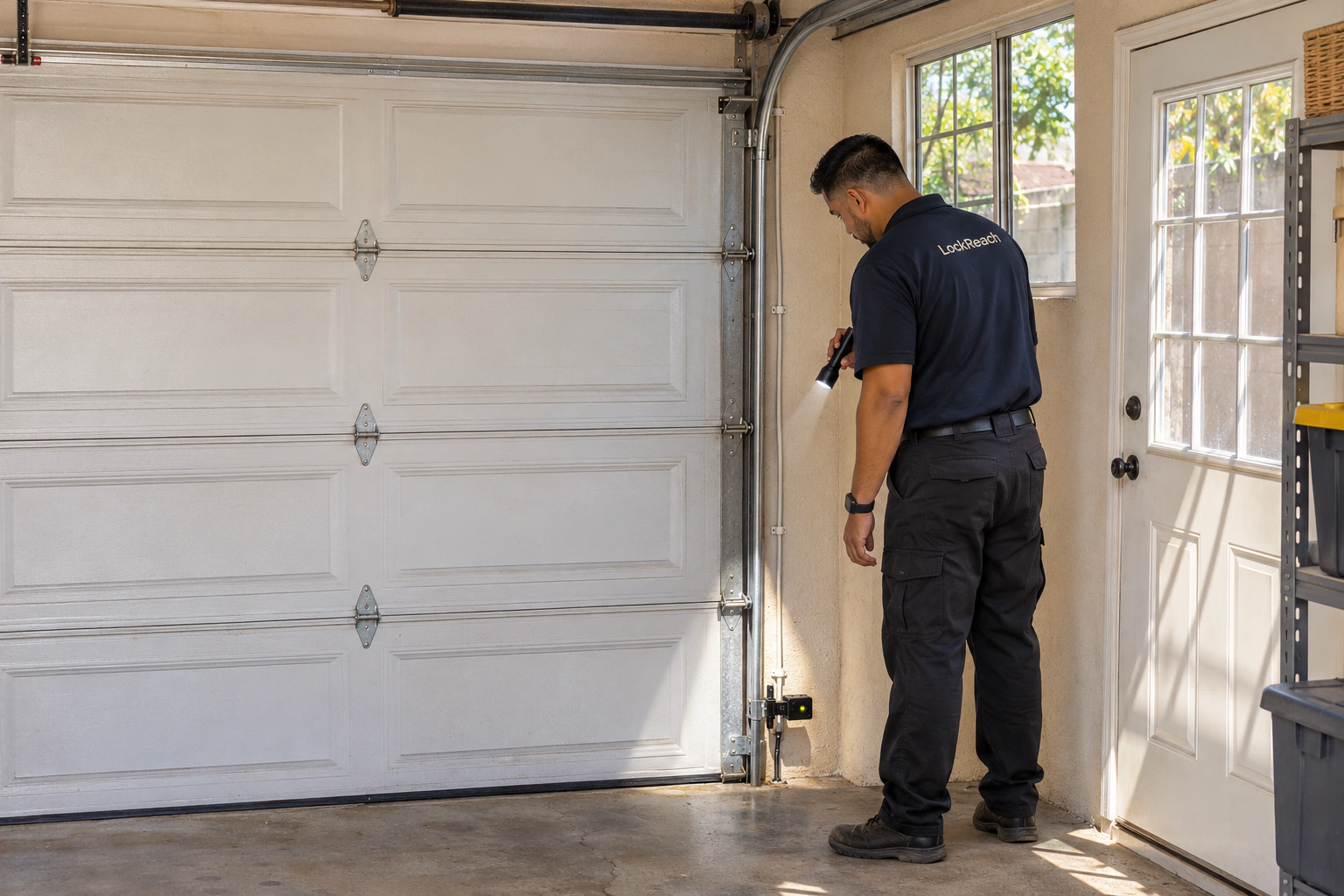
A garage door that stops halfway, sits crooked or refuses to close needs a clear diagnosis before another part is selected. LockReach provides a starting point for existing garage door repair in La Puente: describe the symptom, the location and any recent work on the door. Call 626-435-9510 to discuss the next step. This service concerns existing doors and their working components, including springs, cables, tracks, rollers, openers and safety sensors. It is not an offer to install a new garage door or a reason to replace an entire system before the fault is understood.
Separate the door from the machine that moves it
The door is a moving assembly with its own balance, tracks and hardware. The opener supplies movement, but it cannot make a mechanically damaged or badly functioning door healthy. When a door stops, the motor is not automatically the cause. Likewise, a door that appears intact can still have an opener or control issue.
Tell us whether the door begins to move, stops at a consistent point or does not respond at all. Mention any unusual sound, visible tilt or recent impact. If you have already had work done, explain which part was changed and whether the original symptom ever went away. That history helps keep the assessment centered on the unresolved problem.
When it opens but will not close
This is a useful symptom to describe because it narrows the conversation without proving the cause. Safety sensors, an obstruction, control settings or other faults may affect closing. Some openers use lights or a display to communicate a problem. Note what you can see from a safe position and share the opener's brand and model if it is readily visible.
Do not bypass a sensor or repeatedly force the door down to demonstrate the fault. Manufacturer instructions vary by model, and a light pattern should not be interpreted as a universal diagnosis. If something is visibly in the doorway, keep people and objects clear. A persistent failure to close calls for assessment of both the protective system and the door's operation.
Springs and cables need an assessment of the whole door
A spring or cable problem can affect the way the door is supported and moves. A door that suddenly feels wrong, appears uneven or has visible damage should not be repeatedly operated. Keep away from the moving parts and describe the condition when arranging help. Do not attempt to adjust spring tension or move a loose cable back into place yourself.
The repair discussion should account for the actual door and the existing hardware. Selecting a part is not simply a matter of choosing something that looks similar. Ask what has failed, how the proposed component fits the door and what checks will be carried out after the work. The goal is to restore appropriate operation, not merely to exchange a visible part.
A crooked or noisy door may have more than one contributing issue
Track, roller and other hardware problems can change the path of the door or the effort needed to move it. Tell us whether the noise happens at the start, at a particular point or throughout the travel. If the door was struck by a vehicle or an object, mention that even when the visible mark seems small.
Avoid trying to straighten a track while the door is loaded or attempting to push a displaced door back into place. The apparent symptom may not reveal which components are carrying weight. The appropriate work depends on an inspection. If damage is outside the available repair scope, that needs to be explained rather than hidden behind a promise that any door can be fixed.
Opener repair begins with the equipment already installed
If the opener responds inconsistently, identify the model and the control that is causing trouble. A wall control and a handheld remote may behave differently. Mention whether the opener has power and whether the issue appeared after a power interruption, a recent repair or no obvious change. These are observations, not reasons to remove covers or test wiring.
The technician needs to distinguish an opener fault from resistance or another problem in the door itself. Ask why a particular repair is recommended and what evidence supports it. If a replacement component is proposed, confirm compatibility and scope before authorizing the work. This page does not promise support for every opener model or advertise installation of a new door.
Make access to the existing garage straightforward
La Puente has an established stock of homes, and the way a garage is reached can vary from property to property. Say whether there is another entrance, whether the vehicle is trapped inside and whether the door is currently open, closed or partly raised. Do not move beneath an unstable door to clear space for a visit.
For a rental or a garage associated with a shared property, have the responsible owner or manager involved. Explain any access restriction before the appointment is arranged. The street address, the actual garage entrance and the person who can approve work are more useful than an assumption that every garage is directly accessible from the front driveway.
Ask how the diagnosis will be confirmed
If an earlier repair did not solve the issue, make that part of the first conversation. A second proposed part should come with an explanation of how it relates to the remaining symptom. Ask what will be tested and how the result will be checked before the job is finished. A sequence of replacements is not, by itself, evidence that the cause has been found.
Discuss the proposed price and scope before authorizing repairs. If inspection reveals additional damage, the new recommendation should be explained separately. Keep a record of parts and work already carried out so that the next conversation does not start from incomplete information. An honest account of what remains uncertain is more useful than a remote diagnosis made with confidence.
The finish is a working check, not just a fitted part
The agreed repair should be followed by checks relevant to the problem and the equipment. Ask how the door's movement and safety functions have been assessed, and what you should watch for in normal use. If the original symptom was intermittent, explain the circumstances in which it appeared so they can be considered during the handover.
For existing garage door repair in La Puente, call LockReach at 626-435-9510. Start with what the door is doing and what has already been tried. We can discuss a visit that focuses on the present door, the cause of the problem and a clearly explained next step, without turning a repair request into an automatic new-door proposal.
A few useful answers.
Do you install new garage doors?
This service page is for repairs to existing doors and their working components. New garage door installation is outside the advertised scope.
Can you diagnose a broken spring over the phone?
A description helps prepare for the visit but cannot establish every cause. Keep clear of damaged components and avoid repeated operation while arranging assessment.
Why did replacing a part not fix the problem?
The original symptom may have another cause or more than one contributing fault. Share the work history and ask how the new diagnosis will be checked.