

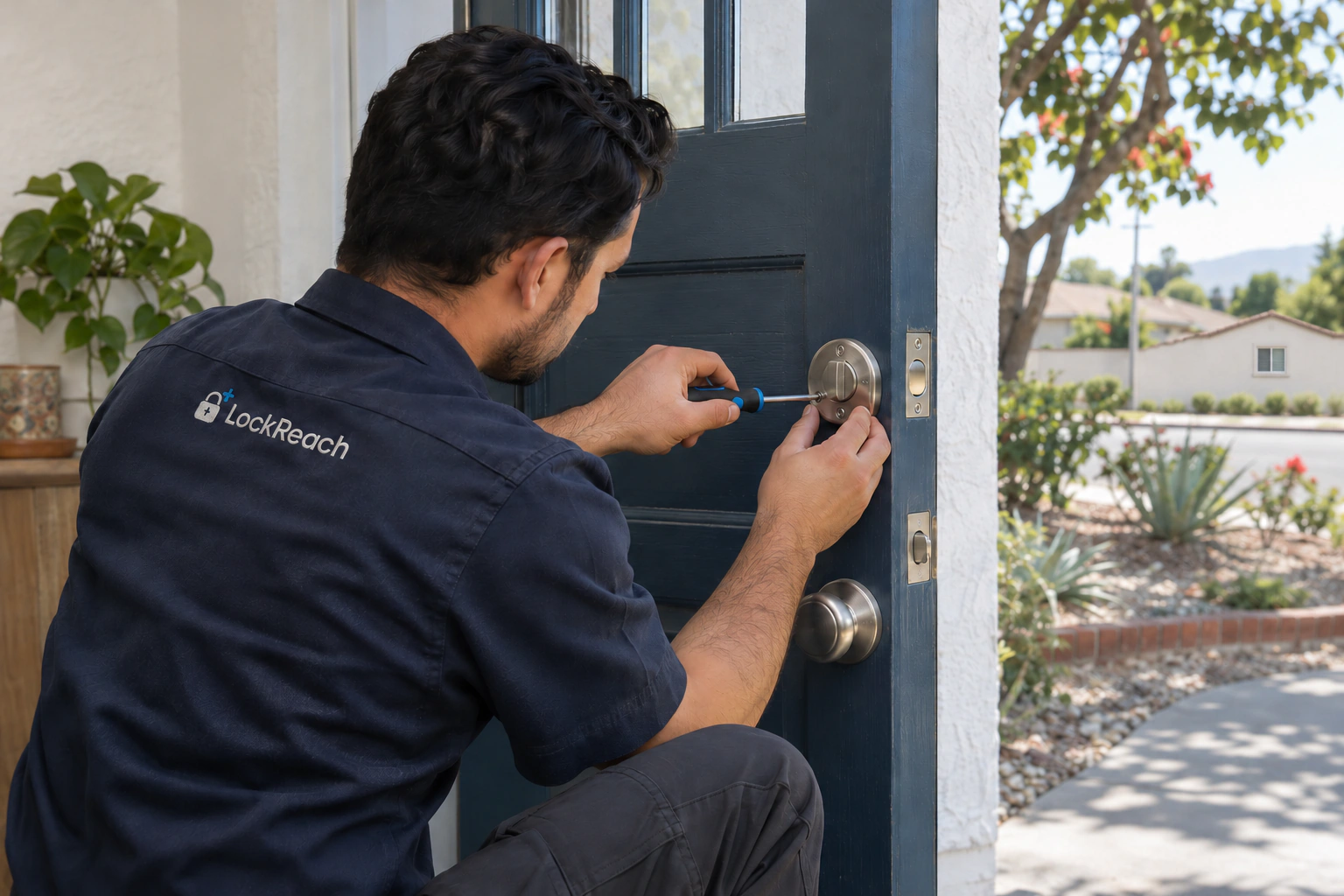
A new set of house keys does not always tell you who else can enter. You may have just moved into a La Puente home, taken over a rental or noticed a lock becoming difficult to use. LockReach's residential locksmith service begins with the reason you want help and the condition of the hardware already on the door. Call 626-435-9510 to talk about rekeying, a lock repair or a change in access. The aim is to decide what your home needs before choosing parts or treating every entrance the same way.
Start with the doors your household actually uses
Walk through which entrances are part of an ordinary day: the front door, a side entrance and perhaps a door connecting the home to the garage. Note which locks use the same key and which do not. You do not need to take anything apart. A short list helps make the conversation specific and reduces the chance of overlooking a regularly used entrance.
La Puente's housing includes established single-family neighborhoods and multifamily properties. At a house, you may be making decisions for several exterior doors. At a unit, the front door may be your responsibility while a shared entrance belongs to the building. Tell us which type of property is involved so the proposed work stays within the right boundaries.
Rekeying changes access while keeping suitable hardware
Rekeying changes the working arrangement inside a compatible lock so a different key operates it. It can be worth discussing after a move, when a key is missing or when someone no longer needs access. It does not automatically repair a worn mechanism, a loose handle or a door that rubs against its frame.
The lock first needs to be suitable for the work. Different types and brands may not be compatible with one another, so do not assume every existing lock can be put on the same key. Describe what is fitted and ask what can reasonably be retained. The decision should reflect both the access change you want and the condition of each lock.
When the door feels wrong, look beyond the key
A key that only turns when you lift the handle or push hard on the door may be telling you more than one thing. The latch and its opening in the frame may not be meeting correctly. Hardware may be loose, worn or affected by the way the door hangs. Simply fitting a different cylinder may leave the original difficulty in place.
Explain whether the problem occurs with the door open, closed or both, if you already know from normal use. Do not repeatedly force it to gather more information. A practical inspection considers how the door closes, how the lock engages and whether the hardware feels secure. The proposed repair should address the symptom you actually reported.
A move is a good time to make access understandable
Before authorizing work, decide who needs regular entry and which doors should remain separate. A family entrance and an independently occupied unit should not be treated as interchangeable just because they share an address. Similarly, a key handed to a contractor for temporary access may need to stop working when that arrangement ends.
Local Census data describes relatively large households in La Puente, but every home has its own routine. The useful question is how your household uses the property. Plan around that routine rather than buying hardware because it appears on a list of upgrades. Keep the discussion focused on exterior access, the people authorized to use it and the locks that are actually installed.
If you rent, bring the responsible person into the conversation
A tenant's immediate problem may be a lockout, while a landlord's decision may concern replacing or rekeying the hardware. Those are related but different requests. Explain which one applies and whether the owner or property manager has approved a change. Have their contact details available when coordination is needed.
For a multifamily building, identify the unit as well as the street address. Tell us whether another secured entrance must be passed to reach your door. Do not assume a unit-level service includes changing a common building lock. Keeping the scope clear helps avoid work that interferes with neighbors or leaves the person responsible for the building out of the decision.
Choosing replacement hardware starts with fit
Sometimes existing hardware is damaged, unreliable or unsuitable for the access arrangement you need. A replacement discussion should cover the door's existing preparation, the position of the latch and the way the lock will be used. A product that looks right in a picture may not fit the door without other work.
If you are considering an electronic lock, mention the exact model rather than assuming all smart locks are interchangeable. Power, operating method and the existing door condition can affect the options. Ask what is included in fitting and checking the hardware, and what remains your responsibility, such as keeping batteries or access settings current. Support depends on the equipment and the proposed job.
Leave with a door that makes sense to use
Before the job is considered complete, check the agreed functions with the responsible person present. The door should close as intended, the lock should operate in normal use and the person using it should understand what has changed. If the original complaint was sticking or unreliable operation, confirm that this has been addressed rather than only testing a key once.
Ask for a clear record of the work and any parts supplied. If some hardware was left in place because it needs a separate decision, make that distinction explicit. Knowing which doors were rekeyed or repaired is more useful than a general statement that the house was serviced. It also makes any later question easier to explain.
Talk through the change you want to make
You do not need a complete hardware specification before calling. Describe the property, the doors involved and whether your concern is access, reliability or both. A home near a busy commercial corridor may have a side entrance used more often than the front; a unit may require coordination through a building manager. Those ordinary details help the work fit the property.
Call LockReach at 626-435-9510 for residential locksmith help in La Puente. We can begin with the locks you already have and the result you want: a reliable entrance, a clearer access arrangement or confidence that an old key no longer controls the doors included in the agreed work.
A few useful answers.
Is rekeying the same as replacing a lock?
No. Rekeying changes which key works in suitable existing hardware. Replacing a lock changes the hardware itself. Condition and compatibility determine what is appropriate.
Can several doors use one key?
Sometimes, if the locks are compatible. Describe the existing hardware so the options can be assessed rather than assuming every door can be matched.
Can you fix a door that needs pushing to lock?
Describe that symptom when calling. The cause may involve alignment or other hardware as well as the lock, so the door needs assessment.