

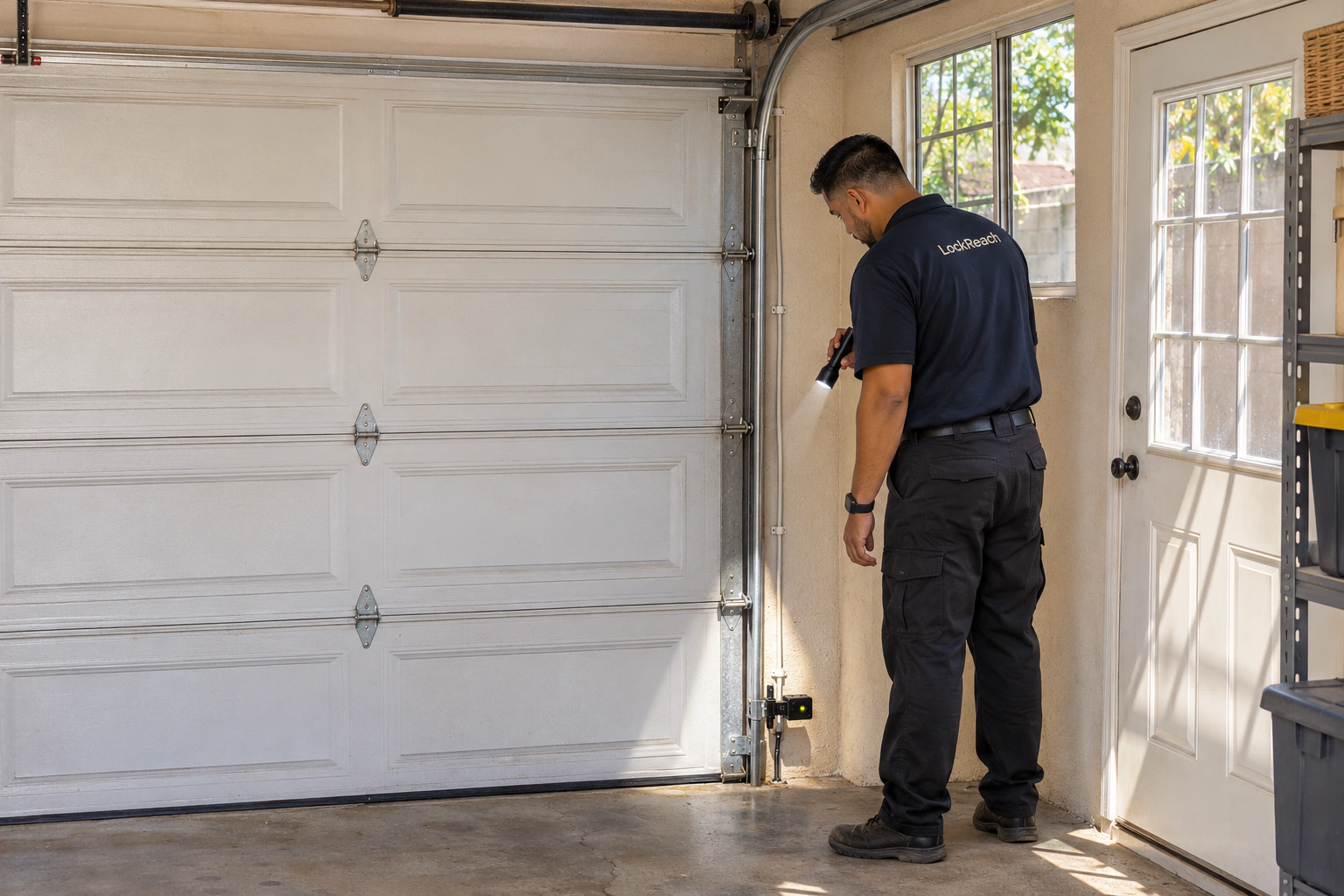
A door that opens normally but refuses to close can leave you wondering whether the opener, sensors or door itself is at fault. The symptom is useful, but it does not prove a diagnosis. This guide covers observations you can make from a safe position before discussing existing garage door repair in La Puente with LockReach. Call 626-435-9510 with the opener model, what happens when you try normal operation and any recent repair history. Do not bypass safety devices or adjust loaded hardware to test a theory.
First, note what actually happens
Does the door remain open without moving, begin to close and reverse, or stop partway down? Does a light flash or a display show a message? Note the sequence without repeatedly operating a door that appears damaged, uneven or unstable. A short description is more useful than guessing a failed part.
If a vehicle or object is visibly in the doorway, keep the area clear. Do not stand beneath a partly raised door or reach into moving components. If the door has been hit, has a loose cable or looks crooked, tell the provider before a visit is arranged.
Sensors are part of the picture, not the only answer
Manufacturer guidance identifies safety-sensor issues as one possible reason an opener will not close a door. A sensor can be affected by obstruction or alignment, but an apparently clean surface does not establish that the whole system works. Model-specific indicators and the installed equipment matter.
Do not tape over, disconnect or bypass a sensor to make the door move. Do not assume that a button-holding technique described for another opener is appropriate for yours. The purpose of the assessment is to restore normal operation with the protective functions working, not to defeat the system that stops closing when it detects a problem.
The door and opener need to be considered together
A moving door can develop resistance or a mechanical fault that affects the opener's behavior. Springs, cables, tracks and rollers are not interchangeable explanations for every symptom, and work on loaded components is not a useful do-it-yourself diagnostic step. Keep clear and report what you have observed.
The opener may also have a control or internal fault. Share the brand and model if safely visible and mention whether the wall control and remote behave differently during ordinary use. Those details help prepare for assessment without pretending a phone description can replace it.
If something was already repaired, say so
Explain which part was changed and whether the original problem disappeared at any point. A door that worked for weeks before developing another fault has a different history from one that never improved. Keep the previous work record available if you have it.
Before authorizing another component, ask how the recommendation relates to the unresolved symptom and what will be checked afterward. You do not need to accuse the earlier provider or diagnose the cause yourself. A clear account of the sequence is enough to make the next discussion more useful.
Prepare the location and the decision-maker
Say whether the garage is attached, behind the house or reached through another entrance. Describe the door's current position and whether there is another way to enter. For a rental or shared property, involve the responsible owner or manager when approval is needed.
Call LockReach at 626-435-9510 to discuss existing garage door repair in La Puente. Ask about availability, the assessment and how the estimate will be confirmed. The requested outcome is a working existing door and an explained repair; this service does not advertise installation of a new garage door.
A few useful answers.
Are clean-looking sensors definitely working?
No. Appearance alone does not confirm alignment, connections or proper operation. The installed system needs assessment.
Should I keep trying the opener?
Avoid repeated operation if the door is damaged, uneven or unstable. Keep clear and describe the condition when arranging help.